


Oracle’s fiscal Q3 could deliver massive cloud and RPO growth driven by AI demand, though it may still fall short of Google Cloud’s 48% hyperscaler growth benchmark.
Oracle’s fiscal Q3 could deliver massive cloud and RPO growth driven by AI demand, though it may still fall short of Google Cloud’s 48% hyperscaler growth benchmark.
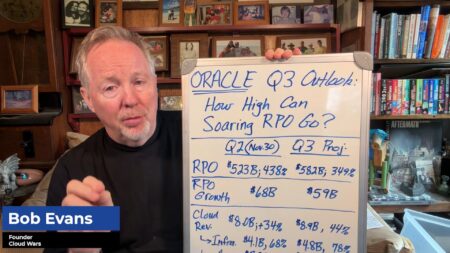
Oracle’s Q3 outlook reveals explosive growth in remaining performance obligations, suggesting the company’s AI training and infrastructure capabilities are driving enormous future demand beyond its OpenAI partnership.
Rejecting “SaaSpocalypse” fears, Aneel Bhusri argues AI will enhance enterprise applications rather than replace them. Workday’s strategy focuses on AI agents embedded within its HR and finance platform to drive new growth and customer value.

The label “legacy” no longer fits Oracle, Microsoft, or SAP, each surpassing 50% cloud revenue. Their rapid cloud growth and AI investments demonstrate that experience, scale, and deep enterprise relationships are powerful assets in today’s AI Era.

Oracle’s new AI agents automate supply chain tasks including planning cycles, sourcing, inventory management, and logistics coordination, helping organizations improve resilience, efficiency, and operational visibility.
Workday cofounder Aneel Bhusri has returned as CEO following Carl Eschenbach’s departure, vowing to lead the company through what he calls its “most pivotal moment” as AI reshapes enterprise software and competitive dynamics.
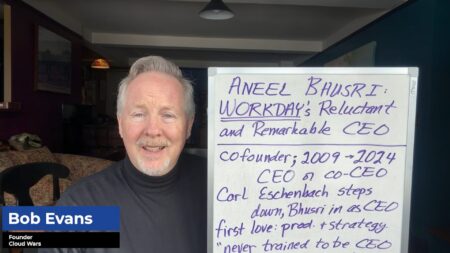
Amid leadership change and fierce competition, Aneel Bhusri’s return underscores Workday’s need for product-centric vision during a defining shift toward AI-powered enterprise software.

Hyperscalers are facing soaring AI demand, with Microsoft, Oracle, AWS, and Google Cloud reporting a massive $1.63 trillion backlog in contracted business not yet recognized as revenue.

The hyperscalers’ record-breaking CapEx surge reflects real AI demand, not a bubble, as backlog growth across the Cloud Wars Top 10 hits historic highs.

SAP outperformed competitors like Oracle and Salesforce, growing its cloud business by 200% more than some rivals.

AWS announces general availability of its European Sovereign Cloud, expanding EU-only infrastructure while meeting strict data sovereignty requirements.

Once dismissed as outdated, Oracle, Microsoft, and SAP are now cloud and AI growth leaders, occupying top Cloud Wars ranks.

Oracle, SAP, and Microsoft use decades of experience to lead cloud-driven business transformations.
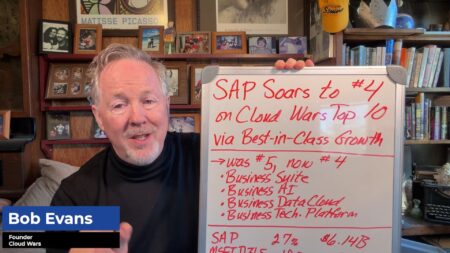
SAP’s cloud-first pivot delivers record performance, with growth nearly double that of Workday and triple that of Salesforce.
As AI reshapes every industry, Oracle AI Database delivers the speed, scale, and data intelligence businesses need to turn AI into real competitive advantage.
Mike Sicilia shares details on the culture and mindset that has boosted Oracle to the #2 spot on the Cloud Wars Top 10 rankings, as highlighted in this recap.
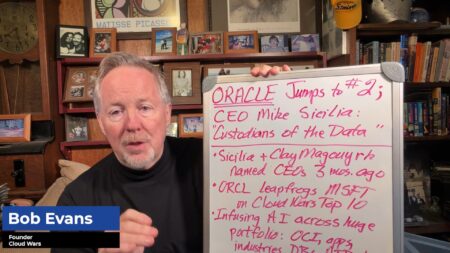
Oracle’s rise to #2 in the Cloud Wars Top 10 rankings is driven by AI innovation, cloud growth, and strong execution from leadership.
Oracle’s AI-first cloud strategy is accelerating customer value, driving rapid growth, and reshaping how enterprises deploy intelligence at scale.

AWS tumbles to #7 as SAP climbs and Palantir rockets up the Cloud Wars rankings, reflecting shifting dynamics in the enterprise AI race.

Google Cloud is now the top-ranked cloud and AI provider, surpassing Microsoft and Oracle, thanks to bold leadership from CEO Thomas Kurian and a relentless focus on customer success in the AI economy.